
Using AI to Write Your Business Website? Here's What Google Wants You to Know
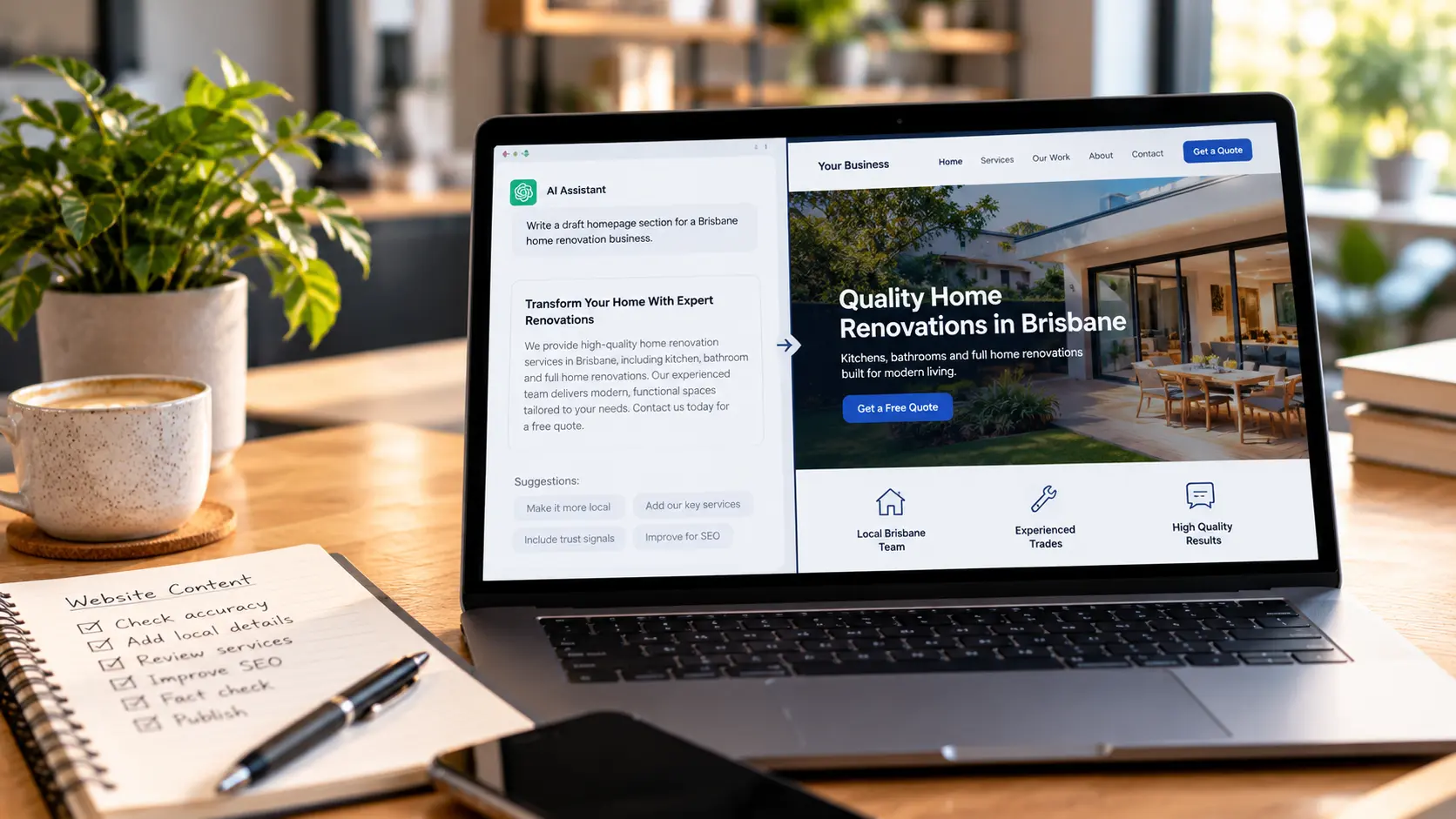
You can ask ChatGPT to write an entire website in a few minutes now. Home page, service pages, FAQs, even product descriptions. It is tempting, especially when you are running a small business and there are ten other things that need your attention.
The problem is that AI does not know your business as well as you do.
It might describe services you do not offer, make up details about your experience or produce paragraphs that sound polished but could belong to almost any business in Australia.
Google updated its guidance on AI-generated content on 1 October 2026, including a reminder to check AI-produced titles, descriptions, alt text and structured data. This is not a new rule saying AI-written pages cannot rank. It is a useful reminder that the person publishing a page is responsible for what is on it.
Here is how I would approach it if I were updating a small-business website.
Does Google penalise AI-written content?
Not simply because AI helped write it.
Google's published guidance focuses on whether content is helpful, reliable and made for people. Using generative AI to produce lots of pages mainly to manipulate search rankings can violate its spam policies. But using AI as a drafting or editing tool is not automatically a problem.
That distinction matters. A carefully reviewed article written with AI assistance can be more useful than a rushed article written entirely by a person. Equally, a hundred near-identical AI service pages can be a poor experience even if every sentence sounds professional.
The question is not just who typed the words. It is whether the page answers something useful and whether the details are true.
Where AI actually helps
I find AI most useful at the beginning and near the end of the writing process.
At the beginning, it can help organise rough notes, suggest questions customers might ask and turn a list of ideas into a sensible outline.
Near the end, it can help shorten awkward sentences, spot repetition and make technical explanations easier to follow.
The part in the middle still needs your input. What do you really do? Which customers do you work with? What problems have you solved? What makes your process different?
Those details are what stop a business website from sounding like a template.
For example, if a Brisbane-based business offers WordPress maintenance, it is more helpful to explain whether the service includes backups, plugin updates, testing after changes and emergency support than to say it provides 'innovative digital solutions' three times.
The mistake I see most often: copy that could describe anyone
Imagine a local plumbing business asks AI to write its services page.
It gets something like:
'We provide high-quality plumbing solutions with a commitment to excellence and customer satisfaction.'
There is nothing particularly wrong with the sentence, but it tells a potential customer almost nothing.
Does the business handle blocked drains? Hot-water repairs? Emergency callouts? Which suburbs does it actually service? Can customers book online? Are there real examples of completed work?
Those are the details a useful page should answer.
You do not need to force 'Brisbane plumber' into every paragraph. You need accurate services, genuine locations, clear contact information and writing that sounds like the business behind the website.
The same principle applies to web development, accounting, cleaning, landscaping and nearly every other local service.
Check every claim before you publish
AI can confidently invent information. That becomes a real issue when the text is published under your business name.
I would pay particular attention to:
- Years of experience, qualifications, awards and certifications
- Customer testimonials and project outcomes
- Pricing, inclusions and guarantees
- Service areas and opening hours
- Legal, tax, medical or technical claims
- Product specifications, compatibility and availability
If you cannot confirm a statement, remove it or rewrite it accurately.
Never publish an invented review or client story. A real example with modest results is far better than an impressive-sounding result that never happened.
This also applies when you use AI to update an older article. Check dates, software versions and links before assuming the information is still current.
Your page title and meta description need a human check too
A lot of businesses use SEO plugins or content tools that offer to generate metadata automatically.
That can save time, but the output still needs a quick review.
Your page title should reflect what the page actually offers. The meta description should help someone decide whether to visit. Neither should promise a service that the page does not provide.
The same goes for image alt text. Alt text is there to describe a meaningful image, particularly for people using assistive technology. It should not be a dumping ground for keywords.
If a photo shows a completed timber deck, describe the deck. Do not fill the alt text with every suburb your business serves.
Google's guidance also mentions structured data. If a tool generates schema markup, check that it matches visible, factual information on the page. Marking up imaginary reviews, services or prices is not a shortcut to better SEO.
What about AI-generated product descriptions?
For a WooCommerce or other online store, AI can help organise product information, especially when you have a large catalogue.
But it needs reliable source material.
Start with the actual product specifications, sizes, materials, compatibility, care instructions and shipping details. Then use AI to turn those facts into readable descriptions.
Do not let it invent dimensions, warranty coverage or features.
If you also publish products through Google Merchant Center, check the applicable rules for AI-generated product information and images. Merchant Center has its own requirements, which should not be confused with general advice about writing a website blog.
And when customers need to judge a real product, use accurate product photos rather than an AI image that makes the item look different from what arrives.
Should you tell readers that AI helped?
There is no single disclosure sentence that fits every use of AI.
If AI helped tidy grammar or organise notes, that is different from publishing a fully synthetic product image or a piece of content where the creation method would matter to readers.
Google advises considering whether disclosure would help readers understand how content was created. For your own business, transparency and accuracy are sensible starting points.
I would rather be clear about the work than add a generic 'written by AI' label to every page without thinking about what it means.
A practical workflow for small businesses
Here is the process I would use before publishing AI-assisted content.
- Write down the real facts first. List the services, locations, products, prices and examples you can verify.
- Use AI for a first draft or outline. Ask it to write clearly, not to invent missing details.
- Add your own experience. Include the questions customers actually ask and the things you explain on calls.
- Remove generic filler. If a paragraph could appear unchanged on a competitor's website, see whether it needs to be there.
- Check facts and links. Especially dates, claims, technical advice and product details.
- Review SEO details. Page title, description, headings, internal links, image alt text and any structured data.
- Read it like a customer. Can someone quickly understand what you offer and what to do next?
- Keep it updated. A good page today can become misleading if the business changes.
This is not a complicated process, but it makes a noticeable difference.
Will AI content help my website appear in ChatGPT or Google AI search?
There is no guaranteed trick that makes an AI assistant recommend your business.
Publishing large volumes of AI-written content is not a substitute for clear, accessible pages and trustworthy information.
The foundations still matter: useful answers, crawlable pages, accurate business details, descriptive headings, relevant internal links and content that explains your services properly.
If you run a Brisbane business, explain what you do and where you actually operate. If you have real project experience, show it. If you sell products, make the information clear and consistent.
Those things help real customers first, and they also make your website easier for search systems to interpret.
The takeaway
AI is a useful writing assistant. I would not avoid it just because Google has updated its guidance.
But I would not hand over the whole website and publish whatever comes back either.
Use it to save time on the repetitive parts, then put your business knowledge back into the content. A shorter, accurate page with a real example is often worth more than a long page full of impressive-sounding sentences.
At Techmendz, that is how we think about website content and SEO. The writing should make sense to the people who might actually become your customers, not just to a tool checking keyword counts.
If your website has been filled with generic AI copy, start by reviewing the pages that matter most: your home page, services, products and contact information. You might not need more content. You might just need better content.
Sources
- Google Search Central, Google Search's guidance about AI-generated content: https://developers.google.com/search/docs/fundamentals/using-gen-ai-content
- Google Search Central, Search Central documentation updates: https://developers.google.com/search/updates
- Google Search Central, Creating helpful, reliable, people-first content: https://developers.google.com/search/docs/fundamentals/creating-helpful-content
- Google Merchant Center Help, Product data specification: https://support.google.com/merchants/answer/7052112